


The Most Common Causes of Shoulder Pain
Share this Post
Shoulder pain is a frequent complaint when patients visit both their primary care providers and orthopedists. While you may think it’s only a problem for young athletes and people whose jobs require physical labor, shoulder pain is actually more widespread than that. It is a major cause of work absence and disability, and multiple studies show that it increases over the age of 50. Here are some of the most common causes of shoulder pain, as well as suggestions for how to treat it that are safer and more effective than most of the conventional methods.
Frequent Causes of Shoulder Pain
Arthritis
There are many types of arthritis (joint inflammation), including rheumatoid arthritis and psoriatic arthritis. However, osteoarthritis is the most prevalent, especially as people age. Osteoarthritis can be caused by numerous things, such as:
-
Joint injuries from sports, falls, etc.
-
Bone deformities
-
Genetics and other health conditions
-
Chronic stress on the joint, including from obesity
-
Sex (women tend to develop arthritis more often)
-
Age
Age is such an important factor because as we grow older, the components of our joints break down. They lose elasticity and cushioning, which is why people often experience arthritis throughout the entire body.
Bone spurs
Bone spurs are really a subcategory of arthritis. They form when the joint degeneration discussed above occurs and the body attempts to repair this by making new tissue, but it backfires.
Osteophytes (another name for bone spurs) can be quite painful. They may make it uncomfortable to lie on one side. They may also impair movement within the shoulder joint, making it hard to raise or rotate your arm. If they rub on tendons or ligaments, bone spurs can cause further pain or even tears.
Bursitis
Bursitis is inflammation of the small fluid-filled sacs (bursae) that provide cushioning in your joints, letting them move smoothly. Believe it or not, there are six bursae in the shoulder joint that can become irritated and swollen, resulting in extreme pain and limited movement.
Usually, shoulder bursitis starts with pain at the top of the arm on the outside of the joint. It then progresses to pain radiating down the arm towards the elbow. Finally, if you stop using your arm to avoid worsening the pain, you can develop muscle atrophy and weakness in the arm.
Frozen shoulder
Also known as adhesive capsulitis, a frozen shoulder brings both pain and stiffness to the shoulder joint. Symptoms may worsen over time and are frequently worse at night. Often a frozen shoulder develops when someone has had to limit shoulder movement, such as after a mastectomy or bone break where the arm is immobilized.
Poor posture or mechanics
This cause of shoulder pain encompasses many contributors, such as:
-
Sitting or standing in a slouched position (including driving, desk work, or even sitting up in bed to read or watch television)
-
Using electronics without good ergonomics (e.g., computer keyboard at the wrong height or distance)
-
Performing repetitive motions incorrectly (a frequent problem for factory workers, landscapers, and others who lift, carry, and push items)
-
Poor positioning while sleeping that twists or puts too much pressure on the shoulder
Your sleep surface can also be a factor here. A mattress and/or pillow that is too soft will allow you to sink too far in and won’t support your head, shoulder, neck, and spinal alignment. A surface that is too firm doesn’t give you the cushioning you need around the shoulder joint and places too much pressure on the point of the shoulder.
Traumatic injury
A trauma to the shoulder causes pain all at once, rather than over time, like the causes listed above. An acute shoulder injury, as this is called in the medical world, can result from:
-
Sports injury, especially one involving bodily contact
-
Falls, such as slipping on the ice or tripping on the stairs
-
Car or bike accident
-
Violent attack (mugging, domestic abuse, etc.)
-
Pushing or pulling too hard, such as trying to lift or move furniture
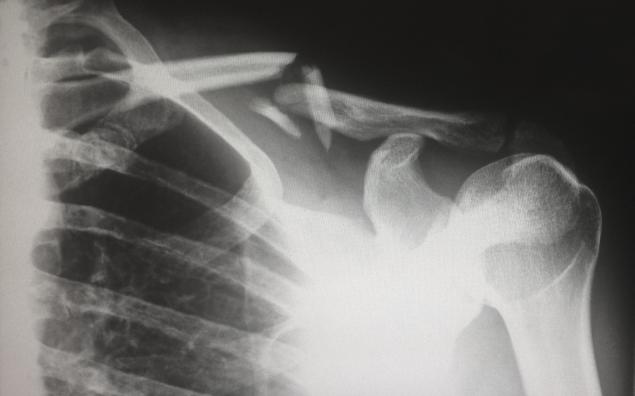
You may hear popping, cracking, or tearing with a traumatic shoulder injury, depending on whether it involves a bone fracture, as in the X-ray image of the broken collar bone (clavicle) above, and what type of soft tissue damage occurs. This type of trauma may also be accompanied by a joint that feels hot to the touch, swelling, and bruising. The pain can be intense, and you may not be able to move your arm. People usually go to the ER when this happens, and even when they receive treatment, the pain may persist for months or years later.
Treatments for Shoulder Pain
Conventional treatments
If shoulder pain persists and interrupts life, most people seek out a doctor. The traditional treatments for shoulder pain include:
-
Rest
-
Ice or heat
-
Physical therapy
-
Acupuncture
-
Massage
-
Lifestyle or exercise changes
-
Over-the-counter medications
-
Prescription drugs
-
Surgery
There are problems, though, with these conventional treatments:
-
They are only appropriate at the time of an acute injury.
-
They treat the pain but not the root cause of the pain.
-
They require massive changes to daily living or work regimens.
-
They cause side effects that can be more dangerous than shoulder pain.
-
They are expensive, particularly when needed for the rest of your life.
-
They may not fix the issue or may even make it worse.
Alternative treatments you may not know about
There are innovative alternative treatments that your doctor may not be aware of. These treatments are better for you because they don’t just mask the pain — they seek to eliminate it at the source whenever possible. And they don’t carry the hazardous adverse events of drugs, the expense of lifetime treatment, or the risks of surgery.
What are these new options for the treatment of shoulder pain? At Core Medical & Wellness, we offer a range of non-surgical orthopedic treatments that merge the best of sports medicine, chronic pain care, and arthritis management. We provide treatments to help you deal with pain now while also exploring alternatives that eliminate pain permanently.
One of our top methods is regenerative medicine. This safe and highly effective therapy harnesses your body’s own healing mechanism through bone marrow concentrate (BMC) or platelet-rich plasma (PRP). Cells are injected into your shoulder joint to kick-start the natural healing process. Regenerative medicine promotes new tissue growth while it reduces pain and inflammation, and it restores range of motion as well. The injected cells keep renewing, so the effects last for months or years after treatment.
Your first consultation with Core Medical can determine if you are a good candidate for some of our alternative treatments for shoulder pain. First, we want to confirm the cause of your shoulder pain and make sure it’s not due to something else, as things like cardiovascular disease and certain medical conditions can also provoke shoulder pain. We use your medical history, a physical exam, and medical imaging to come to a diagnosis. Then, we discuss a treatment plan moving forward, using our best methods for your unique situation.
You don’t have to suffer long term with shoulder pain. To see if regenerative medicine is an option for you, call Core Medical & Wellness today at 888-521-0688, or reach out online to learn more and schedule your initial appointment.