


Degenerative Disc Disease in the Lower Back: What Active Adults Need to Know
Share this Post
Is Your Lower Back Pain From Degenerative Disc Disease? Here’s What You Need to Know
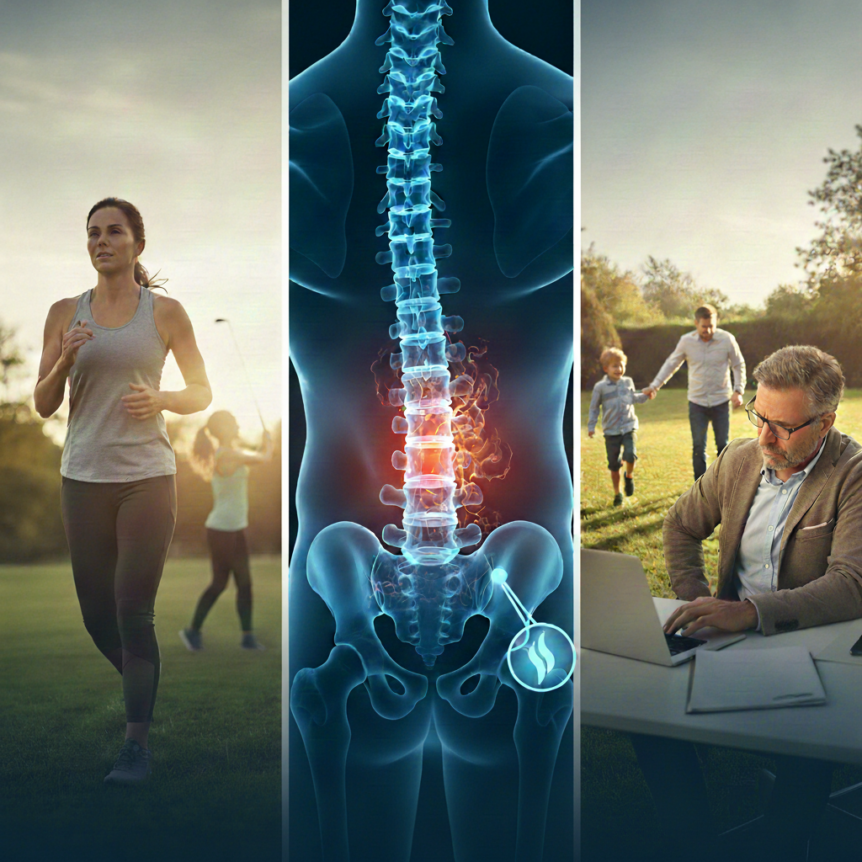
You used to hop out of bed without a second thought. Now your lower back protests every morning. Maybe it aches after your morning run, tightens up after a long day at your desk, or flares after a round of golf or a weekend on the tennis court. You write it off as “getting older”—and honestly, you might not be entirely wrong.
For many active adults in their 40s, 50s, and 60s, that nagging lower back pain has a name: degenerative disc disease. And despite the intimidating label, it is far more manageable than most people assume.
At Core Medical & Wellness in Lyndhurst, NJ, we see this condition every single day—in runners, gym-goers, parents chasing kids around the yard, and professionals who sit at computers for hours on end. This article is for you: the person who refuses to slow down and wants real answers about what is happening in your spine and what you can actually do about it.
What Exactly Is Degenerative Disc Disease?
First, let’s clear something up. Despite having the word “disease” in its name, degenerative disc disease (DDD) is not actually a disease in the traditional sense. It is a description of what happens to the cushioning discs between the vertebrae of your lower back as they age and wear over time.
Think of your spinal discs like the shock absorbers on a car. When they are healthy, they are plump, flexible, and filled with fluid. They let you bend, twist, lift, and move without pain. Over time—and especially with repetitive physical stress—these discs can lose water content, thin out, crack, or bulge. When that happens, they become less effective at absorbing the load your spine carries every day.
The result? Pain, stiffness, and sometimes radiating discomfort into the hips, buttocks, or legs.
Here is the part that surprises most people: many adults have disc degeneration visible on an MRI but feel very little pain. Others have moderate changes on imaging and significant symptoms. The disc itself is only part of the story. How your body responds to those changes—your nerve sensitivity, muscle strength, posture, and overall health—matters just as much.
Why Do Discs Break Down?
Age is the biggest factor, but it is not the only one. Several things accelerate disc degeneration:
Genetics. If your parents had back problems early in life, you may be more prone to disc changes as well. Some people are simply wired to develop these changes sooner.
Repetitive physical stress. Years of heavy lifting, prolonged sitting, bending, or high-impact sports gradually wear on lumbar discs. This is one reason we see disc-related back pain frequently in athletes and people with physically demanding jobs—but also in desk workers whose spines are compressed for eight-plus hours a day without movement.
Prior injuries. A fall, a car accident, or even a sports injury years ago can damage a disc and accelerate how quickly it degenerates. What felt like a “pulled muscle” at the time may have done more structural damage than you realized.
Lifestyle factors. Smoking restricts blood flow to the discs, robbing them of nutrients. Carrying extra weight puts more mechanical load on the lumbar spine. Poor posture compounds both problems.
If you are an active person and some of these hit close to home, you are not alone. Being active is actually one of the best things you can do for your spine—but the type and intensity of activity matters.
Symptoms That Tell You Something Is Wrong
Lower back pain from degenerative disc disease tends to show up in recognizable patterns. You might notice:
A deep, aching pain in the lower back that comes and goes—sometimes calm for weeks, then flaring after a long workout or stressful week at work.
Pain that gets worse with sitting. Sitting compresses the lumbar discs significantly, which is why so many people feel worse at their desk and better when they stand up and move.
Stiffness in the morning or after being in one position too long. Your back needs to “warm up” before it cooperates.
Pain that spreads into the buttocks or hips, sometimes even into one or both legs. When a deteriorating disc bulges and irritates nearby nerves, that nerve pain—called radiculopathy or sciatica—can travel down your leg, sometimes all the way to the foot.
Relief with movement. Many people with disc-related pain feel better walking or changing positions. This is a helpful clue that you are dealing with a disc issue rather than something else.
⚠ Important: If you develop severe leg weakness or loss of bowel or bladder control, seek emergency care immediately. These can signal a serious condition called cauda equina syndrome that requires urgent treatment.
How We Diagnose Degenerative Disc Disease
Diagnosis at Core Medical & Wellness starts with a conversation. We want to understand your full picture—when the pain started, what makes it better or worse, and how it is affecting your workouts, your sleep, and your daily life.
From there, we do a thorough physical exam: checking how your spine moves, how your reflexes respond, whether any nerves are being compressed, and how your core and hip muscles are supporting your lumbar spine.
Imaging—typically X-rays or an MRI—gives us a look at disc height, alignment, and whether there is any nerve compression. But we never treat an MRI in isolation. Imaging findings are only meaningful in the context of your symptoms and your exam. A degenerative disc that shows up on imaging but causes you no pain is not a problem that needs to be fixed.
Non-Surgical Treatments That Actually Work
Here is the good news: the vast majority of people with degenerative disc disease never need surgery. At Core Medical & Wellness, our approach is built around non-surgical care and restoring your function.
Physical therapy and core strengthening are the foundation of long-term improvement. Building strength in the muscles around your lumbar spine—your core, glutes, and hip stabilizers—offloads stress from the discs and reduces pain significantly. Think of it as building a stronger support structure around the problem.
Activity modification does not mean stopping everything you love. It means learning smarter movement patterns. We help you understand which activities to modify temporarily, how to lift correctly, and how to protect your back while staying active.
Anti-inflammatory medications used short-term can take the edge off during flare-ups, giving you enough relief to engage in physical therapy and rehabilitation.
Lifestyle adjustments—weight management, quitting smoking, improving workstation ergonomics, adding low-impact activities like swimming or cycling—can meaningfully slow progression and reduce daily pain.
When You Need More: Interventional Pain Management
Sometimes conservative care alone is not enough, especially if nerve irritation is causing significant leg pain or if a flare has become so severe it is limiting your ability to function. That is where targeted interventional procedures come in.
At Core Medical & Wellness in Lyndhurst, we offer several image-guided, outpatient options for disc-related lumbar pain:
Epidural steroid injections deliver anti-inflammatory medication directly near the irritated nerve roots, reducing inflammation and easing radiating leg pain that makes it hard to walk, stand, or sleep. These are performed under fluoroscopic (X-ray) guidance for precision.
Transforaminal and interlaminar injections allow us to target specific nerve roots affected by disc bulges or herniations—a more precise approach for patients with well-localized nerve symptoms.
Facet joint injections and medial branch blocks address pain coming from the small stabilizing joints behind the discs, which are often stressed when discs lose height.
Spinal cord stimulation is an advanced option for patients with chronic, hard-to-treat lower back and leg pain, particularly those who have had prior back surgery or have not responded to other treatments.
All of these procedures are individualized. There is no protocol that looks the same for every patient, because no two spines—and no two lives—are the same.
What About Regenerative Medicine?
As a practice that emphasizes regenerative and biologic approaches to musculoskeletal pain, we are frequently asked whether regenerative treatments can help degenerative disc disease. The answer is nuanced.
For the disc itself, the evidence for regenerative therapies is still evolving. However, many patients with disc degeneration also have pain coming from surrounding structures—facet joints, sacroiliac joints, and ligaments—where biologic approaches have shown meaningful benefit. We discuss this openly with every patient, including where we believe regenerative therapy can genuinely help and where the evidence is still catching up.
Living Well With a Degenerating Disc
Living with degenerative disc disease does not mean giving up the activities that keep you feeling like yourself. Plenty of people with disc-related back pain continue running, lifting, cycling, hiking, and staying active—with the right plan in place.
The fundamentals that make the biggest difference are staying active rather than resting through the pain, building a strong core and posterior chain, maintaining a healthy weight, avoiding smoking, and following through on your home exercise program. Flare-ups will happen—they are a normal part of the condition. What matters is having a strategy for managing them without losing weeks of progress.
At Core Medical & Wellness, our goal is not just pain reduction on paper. We want you to sit through dinner without wincing, finish your workout without paying for it the next day, and wake up in the morning ready to move.
Ready to Get Answers?
Lower back pain from degenerative disc disease is common—but living with unnecessary pain is not something you have to accept. A careful evaluation, an honest conversation about your goals, and a personalized non-surgical plan can change your daily reality.
If you are in Lyndhurst, Closter, Wyckoff, Kenilworth, Aberdeen, or anywhere in Northern New Jersey and are ready for a different kind of back pain evaluation, Core Medical & Wellness is here.
📞 Contact our office to schedule a consultation →