


MUSE Cell Therapy and Peptides: A Smarter Way to Heal Joint and Spine Pain
Share this Post
Chronic joint and back pain can feel like a trap. You have tried pills. You have tried injections. Maybe surgery has even been suggested. But deep down, you want your body to heal — not just mask the pain.
At Core Medical & Wellness, Dr. Richard Kang takes a different path. He combines MUSE stem cell therapy with Wharton’s Jelly and medical-grade peptides to help damaged joints and spinal tissue truly repair. It is one of the most exciting frontiers in regenerative medicine today.
This guide explains how MUSE stem cell therapy works, why peptides make it stronger, and what kind of results are realistic. You will also learn about safety, FDA status, and who makes a good candidate.
Why Chronic Joint and Spine Pain Is So Hard to Treat
Most chronic pain is not just “inflammation.” Three things are usually happening at once:
- Tissue damage. Cartilage thins, discs dry out, and tendons fray.
- Nerve irritation. Nearby nerves get sensitive and fire pain signals too easily.
- Whole-body inflammation. Sleep, stress, gut health, and hormones all drive background inflammation that blocks healing.
Standard treatments — NSAIDs, cortisone shots, nerve blocks — can dull the pain. But they do not rebuild tissue. That is where regenerative medicine comes in.
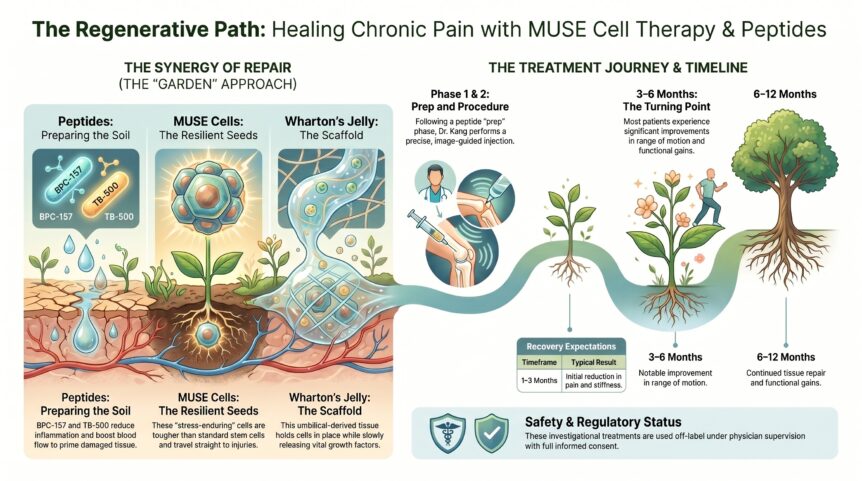
We think of it like growing a garden:
- Peptides prepare the soil. They boost blood flow, calm inflammation, and turn on repair signals.
- MUSE cells and Wharton’s Jelly are the seeds and scaffold. They rebuild damaged tissue and quiet pain at the source.
What Is MUSE Stem Cell Therapy?
MUSE cells (Multilineage-differentiating Stress Enduring cells) are a special kind of stem cell first identified by researchers in Japan. They live inside regular mesenchymal stem cells (MSCs) but behave very differently.
Why MUSE Cells Stand Out
- More versatile. Standard MSCs mainly repair bone, cartilage, and muscle. MUSE cells can support repair across nerve, gut, and organ tissue as well.
- Tougher. They survive low oxygen and high inflammation — the exact conditions inside a worn-out joint or damaged disc.
- Smart homing. MUSE cells use built-in “GPS” receptors to find injured tissue and travel straight to it.
The MUSE-enriched product we use contains a verified 20% MUSE cell concentration inside a Wharton’s Jelly matrix. Research suggests this ratio gives strong results while keeping the safety profile high.
What Is Wharton’s Jelly?
Wharton’s Jelly is the soft, gel-like tissue inside the umbilical cord. It is rich in young stem cells, growth factors, and a natural protein scaffold. When we inject it into a joint, it does two jobs at once:
- Keeps the regenerative cells right where we place them.
- Slowly releases growth factors over weeks and months.
Early studies on Wharton’s Jelly injections show real promise for knee arthritis, with pain and function improvements lasting months after a single treatment.
How Peptide Therapy Fits In
Peptides are short chains of amino acids. Think of them as tiny messenger proteins that tell your cells what to do. In regenerative medicine, two stand out:
- BPC-157 — studied for tendon, ligament, and gut healing.
- TB-500 — studied for tissue repair, blood flow, and reduced inflammation.
Animal studies and early human research suggest these peptides may speed tendon-to-bone healing, reduce inflammatory cell buildup, and support better pain and function. Human trials are still limited, so we use them carefully and with full informed consent.
Why pair peptides with MUSE cell therapy? Because the two work better together. Peptides prime your tissue before the injection and support healing after it, giving MUSE cells a richer environment to do their job.
How the Combined Protocol Works for Your Joints and Spine
Knees, Hips, and Shoulders
Under ultrasound guidance, Dr. Kang injects MUSE-enriched Wharton’s Jelly directly into the damaged joint. The cells home to the worst areas of cartilage and ligament wear. Wharton’s Jelly holds them in place while growth factors release over time.
Most patients notice:
- Less pain and stiffness over the first 1 to 3 months.
- Better range of motion between 3 and 6 months.
- Continued gains up to 12 months.
Back, Neck, and Nerve Pain
Spinal discs are tough places for standard stem cells to survive. MUSE cells are smaller and hardier, so they may reach and support disc and nerve tissue more effectively. For complex spine cases, Dr. Kang may combine targeted spinal injections with an IV infusion to calm nerve sensitivity throughout the body.
What to Expect at Core Medical & Wellness
Phase 1: Evaluation and Prep (Weeks 0–4)
We review your history, imaging, and goals. If you are a good fit, we start a short course of peptide therapy to lower inflammation and improve blood flow before the procedure.
Phase 2: The Procedure (Day 0)
Dr. Kang performs the MUSE-enriched Wharton’s Jelly injection under image guidance. The visit typically takes less than an hour, and most patients go home the same day.
Phase 3: Recovery and Support (Months 1–12)
You continue peptide support, targeted physical therapy, and optional exosome booster treatments. We track pain, function, and imaging at regular follow-ups.
Safety and FDA Status: What You Should Know
Regenerative medicine is powerful, but it is also evolving. Here are the facts, straight:
- MUSE-enriched Wharton’s Jelly products are not FDA-approved to treat joint or spine conditions. They are used off-label under physician supervision.
- Peptides like BPC-157 and TB-500 are not FDA-approved drugs. The FDA lists BPC-157 as a Category 2 bulk drug substance, which limits where it can be legally compounded.
- In April 2026, the FDA announced plans to re-review certain peptides at upcoming advisory committee meetings — but no new approval has been granted.
We talk through every risk, benefit, and alternative before any treatment. Full informed consent is non-negotiable. See our FAQ below for more detail.
Is MUSE Cell Therapy Right for You?
MUSE cell therapy and peptides are not magic bullets. They work best for patients who:
- Have tried standard care and want to delay or avoid surgery.
- Are motivated to support healing with movement, nutrition, and rest.
- Understand the treatments are investigational and want to make an informed choice.
As a dual board-certified pain management and anesthesiology physician, Dr. Kang helps you weigh every option — including more traditional interventional pain treatments — so you can pick the path that fits your goals.
Frequently Asked Questions About MUSE Cell Therapy
What is MUSE cell therapy?
MUSE cell therapy uses a special type of pluripotent stem cell called a Multilineage-differentiating Stress Enduring (MUSE) cell. These cells survive harsh conditions and naturally travel to damaged tissue to support repair of cartilage, bone, nerve, and other cell types.
Is MUSE cell therapy FDA-approved?
No. MUSE-enriched Wharton’s Jelly products are not FDA-approved for joint or spine conditions. They are used off-label under physician supervision. Patients receive full informed consent before any treatment.
How is MUSE cell therapy different from regular stem cell therapy?
Regular mesenchymal stem cells mostly repair bone, cartilage, and muscle. MUSE cells are more versatile, tougher, and better at finding damaged tissue on their own, which may lead to stronger results in arthritic joints and degenerative discs.
Are BPC-157 and TB-500 peptides safe?
BPC-157 and TB-500 are not FDA-approved drugs, and long-term safety data in humans is limited. Short-term studies and clinical experience suggest a favorable safety profile when used under a qualified physician, but patients should understand the investigational nature and legal status of peptide therapy.
How long before I feel results from MUSE cell therapy?
Most patients notice early changes within 4 to 8 weeks, with more meaningful improvements in pain and function between 3 and 6 months. Benefits often continue to build for up to a year after treatment.
Who is a good candidate for regenerative medicine at Core Medical & Wellness?
Good candidates have chronic joint, tendon, or spine pain that has not responded fully to conservative care. Dr. Kang reviews your imaging, health history, and goals during a consultation to help you decide if MUSE cell therapy and peptides are the right next step.
Ready to See If MUSE Cell Therapy Can Help You?
If you are tired of living with joint or spine pain and want to explore a regenerative path, we would love to meet you. Dr. Richard Kang and the team at Core Medical & Wellness will review your case, answer your questions, and build a plan around your goals.
Or call us directly:201-729-0001
Medical Disclaimer: This article is for educational purposes only and does not replace a consultation with a qualified medical provider. Regenerative biologics such as umbilical cord–derived Wharton’s Jelly and MUSE-enriched cell products, along with peptides like BPC-157 and TB-500, are not approved by the U.S. Food and Drug Administration to diagnose, treat, cure, or prevent any disease. These therapies are considered investigational and, when used, are offered off-label under physician supervision. Individual results vary. Always consult your physician before starting any new treatment.